Posted from Hong Kong, China
Yeah, that's Mount Everest. Un-freakin'-believable!
Monday, March 31, 2008
Wednesday, March 26, 2008
Taste of a New Generation
Posted from Kathmandu, Nepal
Aside from our daily life in the orphanage, we've got our fingers in a few other pies. Last weekend we spent the night drinking and laughing in Thamel, the backpacker ghetto of Kathmandu. In the space of 30 minutes we met a bunch of kids who came to Kathmandu for its party scene and its easy access to hash as well as a group of climbers who were planning on tackling Everest in the coming week. Back in our village, VSN is building a school, and we have been given the task of painting the classrooms. So far, we've painted the alphabet and number line in one classroom, and I think we'll be finished with the other three rooms by the time we leave.
Last night, we had a big going-away dinner for a couple from The Netherlands, who are responsible for raising the funds necessary to run the orphanage. Just to give you an idea of how little money it takes to properly run a caring, clean orphanage, this couple raised $50,000, and that allowed VSN to buy the property, build the orphanage, and operate it for the next 2 years! Lizzi has more to say about the dinner itself :)
Other than all that, it's life as usual. We watch Aladdin every day with the kids. But they get no more than an hour into it before they have to go to school or the power goes out. So we start over from the beginning each day. I'm looking forward to the 16-hour flight home just so I can watch a different movie. Maybe one that doesn't have animated genies and monkeys.
Oh, one more thing. The village we live in is called Pepsicola. Yeah, as in, Pepsi, Michael Jackson and the taste of a new generation. Recently, Pepsi built a bottling plant in the undeveloped suburbs of Kathmandu, and the town that grew around it became known as Pepsicola. It still cracks me up to hear the bus-wallahs yelling " Baneshwor, Pepsicola, ..." as they careen through the city streets.
Aside from our daily life in the orphanage, we've got our fingers in a few other pies. Last weekend we spent the night drinking and laughing in Thamel, the backpacker ghetto of Kathmandu. In the space of 30 minutes we met a bunch of kids who came to Kathmandu for its party scene and its easy access to hash as well as a group of climbers who were planning on tackling Everest in the coming week. Back in our village, VSN is building a school, and we have been given the task of painting the classrooms. So far, we've painted the alphabet and number line in one classroom, and I think we'll be finished with the other three rooms by the time we leave.
Last night, we had a big going-away dinner for a couple from The Netherlands, who are responsible for raising the funds necessary to run the orphanage. Just to give you an idea of how little money it takes to properly run a caring, clean orphanage, this couple raised $50,000, and that allowed VSN to buy the property, build the orphanage, and operate it for the next 2 years! Lizzi has more to say about the dinner itself :)
Other than all that, it's life as usual. We watch Aladdin every day with the kids. But they get no more than an hour into it before they have to go to school or the power goes out. So we start over from the beginning each day. I'm looking forward to the 16-hour flight home just so I can watch a different movie. Maybe one that doesn't have animated genies and monkeys.
Oh, one more thing. The village we live in is called Pepsicola. Yeah, as in, Pepsi, Michael Jackson and the taste of a new generation. Recently, Pepsi built a bottling plant in the undeveloped suburbs of Kathmandu, and the town that grew around it became known as Pepsicola. It still cracks me up to hear the bus-wallahs yelling " Baneshwor, Pepsicola, ..." as they careen through the city streets.
Sunday, March 23, 2008
Namaste from Nepal!
Posted from Kathmandu, Nepal
We've been in Nepal for an entire week and it's one of those weeks that feels like a lifetime and a moment, at the same time. I know that there are some of you out there who are just dying to know what it's like for us over here, and in the next few paragraphs, I'm going to do my best to give you a mental picture. Briefly though, you should know that of all of the places we've been, of all of the experiences we've had in the past 3.5 months, of all of the things we've seen and done, Nepal is the best and most amazing.
As Matt said, life in Nepal is a lot calmer than life in India. Which is to say that there are still honking cars, cows in the road, power cuts, touts, undrinkable water, trash in the fields, and tons of tourists, but there are just way fewer of all of those things. It doesn't hurt that Kathmandu is in a valley, surrounded by these beautiful mountains that everyone around here refers to as hills. They're mountains to me! We're hoping to catch a plane to check out some of those really famous peaks that are about 100 km from here this weekend. (And Andy, we'll be in a plane the whole time, so we shouldn't need the Diamox!)
We're slowly but surely getting used to the power cuts and the repitious meals. But seriously people, daal bhaat really IS good. And for the vegan that reads this website: I am learning how to make it because it is seriously the most nutritious complete meal I have ever eaten. While we're talking about food, I should take a moment to tell you about mo:mo. They're these little dumplings that look like something you get at a chinese restaurant, but they're just...BETTER. Also vegan-able. They are delicious with a glass or three of Everest Beer. Yes, people, Everest Beer.
The majority of our time, at least, the part of our day that takes the most energy, is spent with the seven little reasons that it's going to be so hard to leave this amazing place.
Ramesh is 8 and he is the newest addition to the orphanage. All of his living relatives died and kind neighbors brought him to VSN when they found him living on the street. He has never been to school. He eats like he might not get another meal. But at the end of every day, when he's tired and doesn't want to admit it, he likes to curl up in Matt's lap. And just yesterday, he read me an entire alphabet's full of words, in English!
Sangita is the leader of the group. She's 7-and-a-half and she's the kind where the half is really, really important. She reminds me of a woman I used to work with in Maine, because she's got this big belly laugh that just invites your own laughter, even when you have no idea what's funny. She loves, like absolutely LOVES, to sing and dance. The bedtime ritual includes a nightly performance by Sangita. I plan to take a video of it to share with you guys who want to have your heart smitten with love for this sweet little girl.
Sujan and Poonam are siblings. Sujan is 7 and he's just got so much energy that he occasionally needs to let it out by doing gymnastics off of his bunk bed and splitting his head open right before bedtime. True story. Remind me to tell you about that time I was in Nepal and this kid cracked his head open and needed 5 stitches and there was no anesthesia and a pair of rusty scissors. Sujan is the kind of kid whose affection you sort of have to win. But once you win it, every so often you'll look over at him and catch him looking at you and winking and smiling this shy little smile and you just want to scoop him up and kiss his devilish little cheeks. Poonam is absolutely the smiliest kid I've ever met. Except that she also seems to know the power of her tears and will cry when she's not getting her way. I totally identify with her, because I remember being 5 and feeling sad enough to wail about nothing at all. She also feels a really strong connection with Matt and will walk up to him about 5 or 6 times a day just to grin and run away.
Vijay is the most ticklish of the group. He's also 5 and is a very, very happy kid. He's so ticklish that you can stand about a foot away from him, wiggle your finger in his general direction, and watch him fall to the floor, laughing and gasping for air. Because he's quiet and very unassuming, I tend to forget that he's there. But then he'll run up to me with his notebook in his hand, grinning and saying my name (which sounds a lot like "Lijjy" over here) and screaming, "tickle, tickle, tickle!"
Vivek and Vikesh are also siblings. Vivek is 4 and Vikesh is 2 and they're both just so cute that I have to remind myself not to hold them all the time. vivek is the type of kid who would probably be considered ADD at home, but here he's just got a ton of energy, is surrounded by kids twice his age, and has already experienced a life that's harder than most of us will ever dare to have nightmares about. Even in the week that we've been here, he's calmed down more, which could partly be due to the fact that he and his brother were finally united last week. Vikesh is just a little smooshy thing, always wanting to be carried, trotting around behind the older kids just in case they remember him and want to play with him.
Before we came here and spent this time with these kids, I knew that kids could be amazing and inspiring. I knew that they could make you sit back and take stock of your life and wonder what on earth you were doing before they came along. I knew that someday, when the time is right, I would want to come to a country a lot like Nepal and adopt a kid a lot like any of the kids at this orphanage. Here's what I didn't know: I didn't know that you could fall in love with a kid in an instant. I didn't know that loving a child is probably one of the easiest things to do, even when that child isn't yours, and can only say "Hello, how are you I am fine thank you" in your language. I didn't know that an orphanage could be a happy place, filled with laughter and songs and kids who are healthy and sweet and amazing. I also didn't know that despite the happiness of the New Life Children's Home, that once a day a kid like Sangita walks over to the corner, and looks out at the room with an expression on her face that spells the sadness of a thousand lost experiences. I didn't know that a kid like Ramesh would walk up and tell me that he didn't have a mother and he didn't have a father, but that he would really like both, please. I knew that being here would plant a teeny tiny seed of change in me, in the way I think about the world and the hungry and lonely children who live in it. I just didn't expect it to happen so quickly.
We've got just under a week left in this amazing little corner of the world. That's 13 meals of daal bhaat, at least three plates of mo:mo, heaps of Everest Beer, and as many hugs and kisses and tickles as I can fit into the next 6 days.
We've been in Nepal for an entire week and it's one of those weeks that feels like a lifetime and a moment, at the same time. I know that there are some of you out there who are just dying to know what it's like for us over here, and in the next few paragraphs, I'm going to do my best to give you a mental picture. Briefly though, you should know that of all of the places we've been, of all of the experiences we've had in the past 3.5 months, of all of the things we've seen and done, Nepal is the best and most amazing.
As Matt said, life in Nepal is a lot calmer than life in India. Which is to say that there are still honking cars, cows in the road, power cuts, touts, undrinkable water, trash in the fields, and tons of tourists, but there are just way fewer of all of those things. It doesn't hurt that Kathmandu is in a valley, surrounded by these beautiful mountains that everyone around here refers to as hills. They're mountains to me! We're hoping to catch a plane to check out some of those really famous peaks that are about 100 km from here this weekend. (And Andy, we'll be in a plane the whole time, so we shouldn't need the Diamox!)
We're slowly but surely getting used to the power cuts and the repitious meals. But seriously people, daal bhaat really IS good. And for the vegan that reads this website: I am learning how to make it because it is seriously the most nutritious complete meal I have ever eaten. While we're talking about food, I should take a moment to tell you about mo:mo. They're these little dumplings that look like something you get at a chinese restaurant, but they're just...BETTER. Also vegan-able. They are delicious with a glass or three of Everest Beer. Yes, people, Everest Beer.
The majority of our time, at least, the part of our day that takes the most energy, is spent with the seven little reasons that it's going to be so hard to leave this amazing place.
Ramesh is 8 and he is the newest addition to the orphanage. All of his living relatives died and kind neighbors brought him to VSN when they found him living on the street. He has never been to school. He eats like he might not get another meal. But at the end of every day, when he's tired and doesn't want to admit it, he likes to curl up in Matt's lap. And just yesterday, he read me an entire alphabet's full of words, in English!
Sangita is the leader of the group. She's 7-and-a-half and she's the kind where the half is really, really important. She reminds me of a woman I used to work with in Maine, because she's got this big belly laugh that just invites your own laughter, even when you have no idea what's funny. She loves, like absolutely LOVES, to sing and dance. The bedtime ritual includes a nightly performance by Sangita. I plan to take a video of it to share with you guys who want to have your heart smitten with love for this sweet little girl.
Sujan and Poonam are siblings. Sujan is 7 and he's just got so much energy that he occasionally needs to let it out by doing gymnastics off of his bunk bed and splitting his head open right before bedtime. True story. Remind me to tell you about that time I was in Nepal and this kid cracked his head open and needed 5 stitches and there was no anesthesia and a pair of rusty scissors. Sujan is the kind of kid whose affection you sort of have to win. But once you win it, every so often you'll look over at him and catch him looking at you and winking and smiling this shy little smile and you just want to scoop him up and kiss his devilish little cheeks. Poonam is absolutely the smiliest kid I've ever met. Except that she also seems to know the power of her tears and will cry when she's not getting her way. I totally identify with her, because I remember being 5 and feeling sad enough to wail about nothing at all. She also feels a really strong connection with Matt and will walk up to him about 5 or 6 times a day just to grin and run away.
Vijay is the most ticklish of the group. He's also 5 and is a very, very happy kid. He's so ticklish that you can stand about a foot away from him, wiggle your finger in his general direction, and watch him fall to the floor, laughing and gasping for air. Because he's quiet and very unassuming, I tend to forget that he's there. But then he'll run up to me with his notebook in his hand, grinning and saying my name (which sounds a lot like "Lijjy" over here) and screaming, "tickle, tickle, tickle!"
Vivek and Vikesh are also siblings. Vivek is 4 and Vikesh is 2 and they're both just so cute that I have to remind myself not to hold them all the time. vivek is the type of kid who would probably be considered ADD at home, but here he's just got a ton of energy, is surrounded by kids twice his age, and has already experienced a life that's harder than most of us will ever dare to have nightmares about. Even in the week that we've been here, he's calmed down more, which could partly be due to the fact that he and his brother were finally united last week. Vikesh is just a little smooshy thing, always wanting to be carried, trotting around behind the older kids just in case they remember him and want to play with him.
Before we came here and spent this time with these kids, I knew that kids could be amazing and inspiring. I knew that they could make you sit back and take stock of your life and wonder what on earth you were doing before they came along. I knew that someday, when the time is right, I would want to come to a country a lot like Nepal and adopt a kid a lot like any of the kids at this orphanage. Here's what I didn't know: I didn't know that you could fall in love with a kid in an instant. I didn't know that loving a child is probably one of the easiest things to do, even when that child isn't yours, and can only say "Hello, how are you I am fine thank you" in your language. I didn't know that an orphanage could be a happy place, filled with laughter and songs and kids who are healthy and sweet and amazing. I also didn't know that despite the happiness of the New Life Children's Home, that once a day a kid like Sangita walks over to the corner, and looks out at the room with an expression on her face that spells the sadness of a thousand lost experiences. I didn't know that a kid like Ramesh would walk up and tell me that he didn't have a mother and he didn't have a father, but that he would really like both, please. I knew that being here would plant a teeny tiny seed of change in me, in the way I think about the world and the hungry and lonely children who live in it. I just didn't expect it to happen so quickly.
We've got just under a week left in this amazing little corner of the world. That's 13 meals of daal bhaat, at least three plates of mo:mo, heaps of Everest Beer, and as many hugs and kisses and tickles as I can fit into the next 6 days.
We're Still Here
Posted from Kathmandu, Nepal
Well, we arrived in Kathmandu with only minor hassle. The plane was 2 hours late. Then, there was no power in the Kathmandu airport, so we couldn't get cash to pay our visa fees. And, finally, our ride wasn't there to pick us up. Pretty typical for us, actually.
Here we are. In Nepal! If I wasn't actually sitting here right now, I don't think I would believe that I was in Nepal. It's a far cry from India, and an even farther cry from home. But it's quiet, and the people are exceptionally friendly. The most noticeable thing about Nepal is how quiet it is compared to India. When we got off the plane, that was the first thing Lizzi noticed. However, I was so used to the constant, ear-splitting level of background noise in India, that I didn't notice the quiet until we'd arrived at our volunteer site. Yeah, it's quiet here.
There are a few things about Nepal aside from the quiet that take a little getting used to. Meals are served twice a day. In fact, it's very nearly the same meal that is served twice a day. It's call daal bhat, which means rice with lentil soup. In fact, it's really rice, lentils, and some type of vegetable curry. If we weren't living in an orphanage with little kids, the daal bhat would also include some spicy pickle. Daal bhat is good, really good, in fact. But I think at the end of two weeks, I'll be ready for something new to eat. Like a cheesesteak!
We also have to get used to the power cuts. The power is turned off in Kathmandu for 8 hours a day. Usually, they break it up, so it's not a single block of blackout time. Most nights the power is out from about 6PM till 9PM. Which is fine because everyone heads to bed at 9PM. And I mean everyone. We thought it was early just because we were staying in a orphanage, and the kids had an early bedtime. But we talked to some of the other volunteers, who are staying with host families, and they also remarked how their families went to bed at 9PM too.
Going to bed at 9PM is fine when you are getting up every morning at 6AM. Yep, that's 6AM in the morning! I haven't voluntarily woken up at 6AM in years. But that's the way it goes here. Up at 6AM, tea at 7AM, daal bhaat at 9AM, off to school/work at 10AM, come home at 6PM, daal bhaat again at 8PM, and then to bed at 9PM. Repeat. It's simple, and it gets the job done, but again I think I'll be ready for a change when we leave.
There's a lot more to say about what we're doing here, which is fantastic work! And all that we're learning -- we're learning to speak Nepali! But it's time for daal bhat #1.
Sunday, March 16, 2008
The Next Two Weeks
Posted from Delhi, India
We realized the other day that we haven't told most of you out there who are reading this blog (hello to the three people who read this blog!) that for the next two weeks, we will be volunteering in Nepal. We're not really sure what we'll be doing, but we're pretty sure we'll be somewhere near Kathmandu and that we'll be connected to an orphanage. We might even get to see those famous mountains. We'll be working with this organization, and from my limited communication with them, they seem pretty cool. So wish us luck! And in the meantime, don't believe everything you read in the paper about Nepal. Our biggest concern is that we're going to freeze our butts off! Think warm thoughts.
This Is India
Written in New Delhi, India
In one scene in the movie Blood Diamond, Leonardo DiCaprio's character says in response to an American journalist grilling him on the brutality and constant power struggles fueled by the contraband diamond trade, "T.I.A." The journalist clarified, "This is Africa." In those three letters, DiCaprio's character sums up hundreds, if not thousands, of years of iniquity, tribalism, poverty, and war. India lacks the violent tribal warfare and a brutal history of tyrants, dictators, and oppressors, but over the course of the past month, Lizzi and I have looked at each other more than a few times and said, "T.I.I." This Is India.
In Kerala, T.I.I. came to mean everything moves at its own pace. There's no rushing it or slowing it down. However, in the North, T.I.I. has taken on an entirely new meaning. This new meaning is like one of those words in the dictionary that has five or six possible definitions. Kind of like something in yiddish.
Our day started where we left off yesterday (the first time we were in Delhi). We'd hired a rickshaw around 4:00PM to take us to see Huyamen's Tomb. We got a little way down the road before the driver pulled over and said that we could see a few other tombs and monuments. They were all things we wanted to see, but it was late, and most sights here close at sunset. He assured us that we could see it all; they were all on the way. So we agreed on a price, and off we went. Of course, he took us to the sight furthest away (the one he suggested), almost an hour. We sprinted through ruins, snapping pictures, thoroughly enjoying ourselves. We hopped back into the rickshaw and we headed to the next place (again, one that he wanted us to see). It was closed. So was the next one, and the next one. In fact, we didn't get to see the one place we wanted to. Then he took us to a "government" tourist office, so we could book a trip to Rajasthan (which we want to do). Of course, all day he'd been telling us that he would take us to the government tourism office, and we pressed him that we wanted the government tourism office. Nope, he took us to a private tour operator, who quoted us an astronomical price. We turned it down. We got back in the rickshaw, and by this time everything was closed. This is India.
Of course, we still needed to get around the next day to see what we hadn't seen. We negotiated the three sights we wanted to see for the same price as we had just paid. He picked us up at the appointed time. No issues there. We got to the mosque. We made it to the Red Fort. We made it to Huyamen's Tomb. We loved the Tomb and spent 2.5 hours there taking pictures and walking around the amazingly well-kept grounds. When we got back to our rickshaw, it was 4:30 and our rickshaw driver scolded us for taking so long to see something that he believed to look exactly like the Taj Mahal (incidentally, he's totally and completely wrong). We had him take us back to our hotel so we could catch a train to Agra, and when we gave him the agreed fee, plus a 100 rupee tip, he balked at us, asking for more money. "But it was the price we agreed upon!" we argued. But he clarified that he'd agreed to take us around for half of the day, and as it was 4:45, we should pay him more. In fact, he wanted to take us to seven different sites, all day, at our agreed-upon price. Knowing that we tend to take longer at the dorky historical sites than most, we told him we'd pay him the same price, but that we only wanted to see three things. Same price. We walked away. This is India.
A quick check at the hotel desk and the travel desk revealed that although both advertised that they would book train tickets for guests, neither was going to help us procure train tickets to Agra. So a trip to the train station was required. We checked out of our room, hauled our bags over to a sketchy luggage storage place, and I headed off to the train station to get train tickets while Lizzi stayed behind to do some Internet work. On the way to the train station, I was fighting off touts left and right, rivaling Luke Skywalker in my skillz. At the entrance to the train station, the rickshaw drivers saw me before I could steady my light saber, and they immediately tried to direct me to a special stand for foreigners. They pointed to a giant blue sign that said "GOVT INDIA" in a building across the street with blacked-out windows. But the sign on the train station clearly read, "International Travelers, Please Book Here" so I ignored the rickshaw drivers and walked in. Or, tried to walk in. Before I could, a man grabbed me by the arm and asked me if I had a ticket. When I explained that I needed to book a ticket (duh, I'm at the train station), he told me that the sign was ineffective, as of 2007. He led me to a booking queue, grabbed a reservation form, told me to fill it out and take it across the street to GOVT INDIA. I thanked him, turned around, and went back to my initial destination. Or, tried to. Touttwo comes up and does the exact same thing. Different guy, same story. But instead of letting me walk back, he physically led me over to GOVT INDIA. So I walk up the stairs, remembering what the guy in the private tour office had told me about being up front about being a private office, and am immediately aware that I am not where I want to be. Nevertheless, I sit down in the chair and express my unending wish to get to Agra. My not-so-helpful new friend kindly informs me that the trains are full. Before he can sell me a $260 cab ride to Agra, I walk out. I walk back to our hotel, find Lizzi at the Internet cafe, explain the situation and tell her that we'll be staying in Delhi for another night, taking a $100 cab ride to Agra the next day, booked through our hotel's tour desk, who was now only too happy to help us. This. This is India, too.
It took four hours to get to Agra instead of the one-hour trip we were assured. T.I.I. But we checked into our hotel, grabbed our cameras, and made our way to the Taj Mahal, determined not to let the stress of the previous three days stop us from getting to our destination. The touts tried to make us pay them to get to the front of the line, but we held strong. T.I.I. We stood in interminably long lines (T.I.I.), said nothing when people cut in front of us (T.I.I) and walked through the turned-off metal detectors (T.I.I.). Once inside, we took a deep breath, walked through the south gate and got our very first glimpse of the Taj. There, in all of its glory, we looked at each other and thought the exact same thing: T.I.I.
In one scene in the movie Blood Diamond, Leonardo DiCaprio's character says in response to an American journalist grilling him on the brutality and constant power struggles fueled by the contraband diamond trade, "T.I.A." The journalist clarified, "This is Africa." In those three letters, DiCaprio's character sums up hundreds, if not thousands, of years of iniquity, tribalism, poverty, and war. India lacks the violent tribal warfare and a brutal history of tyrants, dictators, and oppressors, but over the course of the past month, Lizzi and I have looked at each other more than a few times and said, "T.I.I." This Is India.
In Kerala, T.I.I. came to mean everything moves at its own pace. There's no rushing it or slowing it down. However, in the North, T.I.I. has taken on an entirely new meaning. This new meaning is like one of those words in the dictionary that has five or six possible definitions. Kind of like something in yiddish.
Our day started where we left off yesterday (the first time we were in Delhi). We'd hired a rickshaw around 4:00PM to take us to see Huyamen's Tomb. We got a little way down the road before the driver pulled over and said that we could see a few other tombs and monuments. They were all things we wanted to see, but it was late, and most sights here close at sunset. He assured us that we could see it all; they were all on the way. So we agreed on a price, and off we went. Of course, he took us to the sight furthest away (the one he suggested), almost an hour. We sprinted through ruins, snapping pictures, thoroughly enjoying ourselves. We hopped back into the rickshaw and we headed to the next place (again, one that he wanted us to see). It was closed. So was the next one, and the next one. In fact, we didn't get to see the one place we wanted to. Then he took us to a "government" tourist office, so we could book a trip to Rajasthan (which we want to do). Of course, all day he'd been telling us that he would take us to the government tourism office, and we pressed him that we wanted the government tourism office. Nope, he took us to a private tour operator, who quoted us an astronomical price. We turned it down. We got back in the rickshaw, and by this time everything was closed. This is India.
Of course, we still needed to get around the next day to see what we hadn't seen. We negotiated the three sights we wanted to see for the same price as we had just paid. He picked us up at the appointed time. No issues there. We got to the mosque. We made it to the Red Fort. We made it to Huyamen's Tomb. We loved the Tomb and spent 2.5 hours there taking pictures and walking around the amazingly well-kept grounds. When we got back to our rickshaw, it was 4:30 and our rickshaw driver scolded us for taking so long to see something that he believed to look exactly like the Taj Mahal (incidentally, he's totally and completely wrong). We had him take us back to our hotel so we could catch a train to Agra, and when we gave him the agreed fee, plus a 100 rupee tip, he balked at us, asking for more money. "But it was the price we agreed upon!" we argued. But he clarified that he'd agreed to take us around for half of the day, and as it was 4:45, we should pay him more. In fact, he wanted to take us to seven different sites, all day, at our agreed-upon price. Knowing that we tend to take longer at the dorky historical sites than most, we told him we'd pay him the same price, but that we only wanted to see three things. Same price. We walked away. This is India.
A quick check at the hotel desk and the travel desk revealed that although both advertised that they would book train tickets for guests, neither was going to help us procure train tickets to Agra. So a trip to the train station was required. We checked out of our room, hauled our bags over to a sketchy luggage storage place, and I headed off to the train station to get train tickets while Lizzi stayed behind to do some Internet work. On the way to the train station, I was fighting off touts left and right, rivaling Luke Skywalker in my skillz. At the entrance to the train station, the rickshaw drivers saw me before I could steady my light saber, and they immediately tried to direct me to a special stand for foreigners. They pointed to a giant blue sign that said "GOVT INDIA" in a building across the street with blacked-out windows. But the sign on the train station clearly read, "International Travelers, Please Book Here" so I ignored the rickshaw drivers and walked in. Or, tried to walk in. Before I could, a man grabbed me by the arm and asked me if I had a ticket. When I explained that I needed to book a ticket (duh, I'm at the train station), he told me that the sign was ineffective, as of 2007. He led me to a booking queue, grabbed a reservation form, told me to fill it out and take it across the street to GOVT INDIA. I thanked him, turned around, and went back to my initial destination. Or, tried to. Touttwo comes up and does the exact same thing. Different guy, same story. But instead of letting me walk back, he physically led me over to GOVT INDIA. So I walk up the stairs, remembering what the guy in the private tour office had told me about being up front about being a private office, and am immediately aware that I am not where I want to be. Nevertheless, I sit down in the chair and express my unending wish to get to Agra. My not-so-helpful new friend kindly informs me that the trains are full. Before he can sell me a $260 cab ride to Agra, I walk out. I walk back to our hotel, find Lizzi at the Internet cafe, explain the situation and tell her that we'll be staying in Delhi for another night, taking a $100 cab ride to Agra the next day, booked through our hotel's tour desk, who was now only too happy to help us. This. This is India, too.
It took four hours to get to Agra instead of the one-hour trip we were assured. T.I.I. But we checked into our hotel, grabbed our cameras, and made our way to the Taj Mahal, determined not to let the stress of the previous three days stop us from getting to our destination. The touts tried to make us pay them to get to the front of the line, but we held strong. T.I.I. We stood in interminably long lines (T.I.I.), said nothing when people cut in front of us (T.I.I) and walked through the turned-off metal detectors (T.I.I.). Once inside, we took a deep breath, walked through the south gate and got our very first glimpse of the Taj. There, in all of its glory, we looked at each other and thought the exact same thing: T.I.I.
Spice Box
Written from Udaipur, Rajasthan, India
Posted from Delhi, India
Last night, after spending the day walking around the city palace, but before we went to see Octopussy, Matt and I took a cooking class. Together. I mean, Matt and I cook together all the time. But this was totally different, given that usually when we cook together, I take on the role of the Alpha cook, screaming at him to get me that spoon, no THAT spoon!, and generally being bossy in my domain. Over the years that we've lived together, I've gotten progessively better at sharing the kitchen, but I am a LOOONG way from winning the "Cooperative Cook of the Year" award. So I thought that taking a cooking class together would be interesting, especially as my previous forays into the realm of Indian cooking have turned out surprisingly poor results. It's not surprising because I consider myself such a good cook, but surprising because I want, SO badly, to be able to make Indian food. I am happy to be the first to report that no Weyants were harmed in the process of making the delicious Indian meal we ate last night!
This post is named, not for a B-minus porn flick, but for the cooking class we took. It is also the name of the ubiquitous metal box found in every Indian kitchen. It's a magic box because it contains all of the spices necessary to make a basic curry. And last night, for the first time since I lived with Tejal all those years ago and watched her pull delicious meals out of about 3 ingredients, I finally understood its importance.
Generally speaking, most Indian dishes have very few ingredients. And the spices seem to be the most important part of any meal. As we learned last night, the contents of a spice box include brown cumin, fennel seeds, brown mustard seeds, turmeric powder, coriander seed powder, red chili powder, and fenugreek seeds. Those spices, together with the ever-present garam masala; salt; pepper; black cardamom; and a paste made of onion, garlic, and ginger, form the backbone of almost every single Indian dish you have come to know and love. And here was where I had my Halleluyah! moment. Whenever I have tried to make an Indian dish, my hopes were always dashed at the first taste. I've added enough red chili powder and plenty of cumin. I even went out and bought the expensive garam masala. But I never knew why, if I followed the recipe to a T, my daal never tasted like Tejal's daal, my curries always lacked...SOMETHING. Last night I found the answer in just five words: BROWN mustard seeds and BLACK cardamom! NO WAY! Way. Over here in India, mustard seeds are not pukey yellow. They are brown. And cardamom is both green and black. When I tell you that yes, there certainly IS a difference in flavor, it's like trying emphasize the difference between, say, an 18-year-old Single Malt Scotch and that stuff on the bottom shelf of your liquor store that says, "Whisky" on the label. It's THAT different.
We started off the meal with a glass of chai. Chai is ubiquitous in India, synonymous with a handshake in the US. When someone offers you chai, you drink it. And you drink it every day. Twice a day. THREE times a day. It is sweet and milky and has a nice lingering little spice. It's a warming beverage, but even in the heat of India, it can cool you down. It's amazing stuff. And here I will give a shoutout to Matt, who donned his apron as directed by our (slightly intimidating) teacher and was the first student in the hotseat, making this most-important beverage for our entire class. It was delicious.

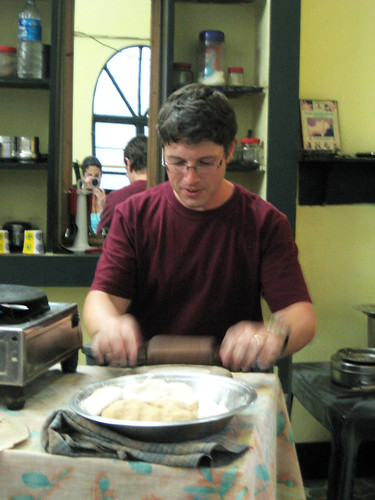
After the chai, we made Khadai Paneer, which is basically paneer (an unfermented cheese), green peppers, and onions in a tomato-based curry. Next came Malai Kofta, which are these fried potato balls in a cream sauce, which, even though they sound heavy, are ridiculously light and delicious. The base of the kofta formed the foundation ingredients for our vegetable cutlets (a potato-vegetable snack that, dare I say it, rival latkes in their yumminess). Then came another cup of tea (of the kashmiri saffron variety) and biryani, which is a rice dish made with a bunch of spices and that ever-delicious basmati rice. Finally, we learned how to make chapati, which is the bread that's actually most often eaten in Indian households (sorry Jules, I too wish that everyone ate Naan all the time), and we each got to take a turn at rolling out and cooking this simple bread.
We ate our dinner as though we hadn't spent the past two hours snacking on the outcomes of our cooking forays, and at the end of the meal, our teacher surprised us with some gulab jamun. If you haven't had it, go, RIGHT THIS MINUTE, to the Indian section of your grocery stores and buy some gulab jamun. It's the sweetest most delicious thing you'll ever eat. I promise. And if you don't like it, which a lot of people don't, because they are crazy and think it's too sweet, that's okay, because I will visit you and eat your leftovers for you.
Now I'm not crazy enough to think that I know how to cook Indian foods after one night in an upstairs kitchen in Udaipur. But I will say that I feel significantly less intimidated by my plethora of Indian cookbooks. Which is lucky for those of you guys living in the Boston area, and particularly for those of you in the Boston area who like Indian food! But the best part is that when I make said Indian food, I might just let Matt help.
Posted from Delhi, India
Last night, after spending the day walking around the city palace, but before we went to see Octopussy, Matt and I took a cooking class. Together. I mean, Matt and I cook together all the time. But this was totally different, given that usually when we cook together, I take on the role of the Alpha cook, screaming at him to get me that spoon, no THAT spoon!, and generally being bossy in my domain. Over the years that we've lived together, I've gotten progessively better at sharing the kitchen, but I am a LOOONG way from winning the "Cooperative Cook of the Year" award. So I thought that taking a cooking class together would be interesting, especially as my previous forays into the realm of Indian cooking have turned out surprisingly poor results. It's not surprising because I consider myself such a good cook, but surprising because I want, SO badly, to be able to make Indian food. I am happy to be the first to report that no Weyants were harmed in the process of making the delicious Indian meal we ate last night!
This post is named, not for a B-minus porn flick, but for the cooking class we took. It is also the name of the ubiquitous metal box found in every Indian kitchen. It's a magic box because it contains all of the spices necessary to make a basic curry. And last night, for the first time since I lived with Tejal all those years ago and watched her pull delicious meals out of about 3 ingredients, I finally understood its importance.
Generally speaking, most Indian dishes have very few ingredients. And the spices seem to be the most important part of any meal. As we learned last night, the contents of a spice box include brown cumin, fennel seeds, brown mustard seeds, turmeric powder, coriander seed powder, red chili powder, and fenugreek seeds. Those spices, together with the ever-present garam masala; salt; pepper; black cardamom; and a paste made of onion, garlic, and ginger, form the backbone of almost every single Indian dish you have come to know and love. And here was where I had my Halleluyah! moment. Whenever I have tried to make an Indian dish, my hopes were always dashed at the first taste. I've added enough red chili powder and plenty of cumin. I even went out and bought the expensive garam masala. But I never knew why, if I followed the recipe to a T, my daal never tasted like Tejal's daal, my curries always lacked...SOMETHING. Last night I found the answer in just five words: BROWN mustard seeds and BLACK cardamom! NO WAY! Way. Over here in India, mustard seeds are not pukey yellow. They are brown. And cardamom is both green and black. When I tell you that yes, there certainly IS a difference in flavor, it's like trying emphasize the difference between, say, an 18-year-old Single Malt Scotch and that stuff on the bottom shelf of your liquor store that says, "Whisky" on the label. It's THAT different.
We started off the meal with a glass of chai. Chai is ubiquitous in India, synonymous with a handshake in the US. When someone offers you chai, you drink it. And you drink it every day. Twice a day. THREE times a day. It is sweet and milky and has a nice lingering little spice. It's a warming beverage, but even in the heat of India, it can cool you down. It's amazing stuff. And here I will give a shoutout to Matt, who donned his apron as directed by our (slightly intimidating) teacher and was the first student in the hotseat, making this most-important beverage for our entire class. It was delicious.
After the chai, we made Khadai Paneer, which is basically paneer (an unfermented cheese), green peppers, and onions in a tomato-based curry. Next came Malai Kofta, which are these fried potato balls in a cream sauce, which, even though they sound heavy, are ridiculously light and delicious. The base of the kofta formed the foundation ingredients for our vegetable cutlets (a potato-vegetable snack that, dare I say it, rival latkes in their yumminess). Then came another cup of tea (of the kashmiri saffron variety) and biryani, which is a rice dish made with a bunch of spices and that ever-delicious basmati rice. Finally, we learned how to make chapati, which is the bread that's actually most often eaten in Indian households (sorry Jules, I too wish that everyone ate Naan all the time), and we each got to take a turn at rolling out and cooking this simple bread.
We ate our dinner as though we hadn't spent the past two hours snacking on the outcomes of our cooking forays, and at the end of the meal, our teacher surprised us with some gulab jamun. If you haven't had it, go, RIGHT THIS MINUTE, to the Indian section of your grocery stores and buy some gulab jamun. It's the sweetest most delicious thing you'll ever eat. I promise. And if you don't like it, which a lot of people don't, because they are crazy and think it's too sweet, that's okay, because I will visit you and eat your leftovers for you.
Now I'm not crazy enough to think that I know how to cook Indian foods after one night in an upstairs kitchen in Udaipur. But I will say that I feel significantly less intimidated by my plethora of Indian cookbooks. Which is lucky for those of you guys living in the Boston area, and particularly for those of you in the Boston area who like Indian food! But the best part is that when I make said Indian food, I might just let Matt help.
Subscribe to:
Posts (Atom)